Solid Cast Aluminum vs. Architectural Bronze vs. Cut Metal House Numbers
Walk up to a historic civic courthouse, a mid-century Palm Springs residence, or a custom limestone estate, and you immediately sense the difference between authentic architectural metal lettering and hollow big-box store hardware. True architectural numbers possess physical depth, crisp stroke geometry, and alloy permanence measured in decades rather than seasons.
When specifying custom signage on ArchitecturalNumbers.com, buyers choose between two core American manufacturing processes—foundry-poured dimensional casting and precision waterjet/router-cut solid plate—across two primary non-ferrous alloys: architectural aluminum and copper-tin architectural bronze. Understanding how each metal and profile behaves on the wall ensures you invest in the right alloy for your facade, climate, and budget.
Why Foundry-Cast Metal Outclasses Hollow Stamped & Zinc Die-Cast Hardware
Mass-market hardware-store house numbers are typically stamped from thin sheet metal or injection-molded from brittle pot-metal zinc (Zamak) plated with a microscopic flash of lacquer. Within two or three winters, moisture creeps behind cracked clearcoats, blistering the plating and streaking rust or white zinc corrosion down fresh stucco.
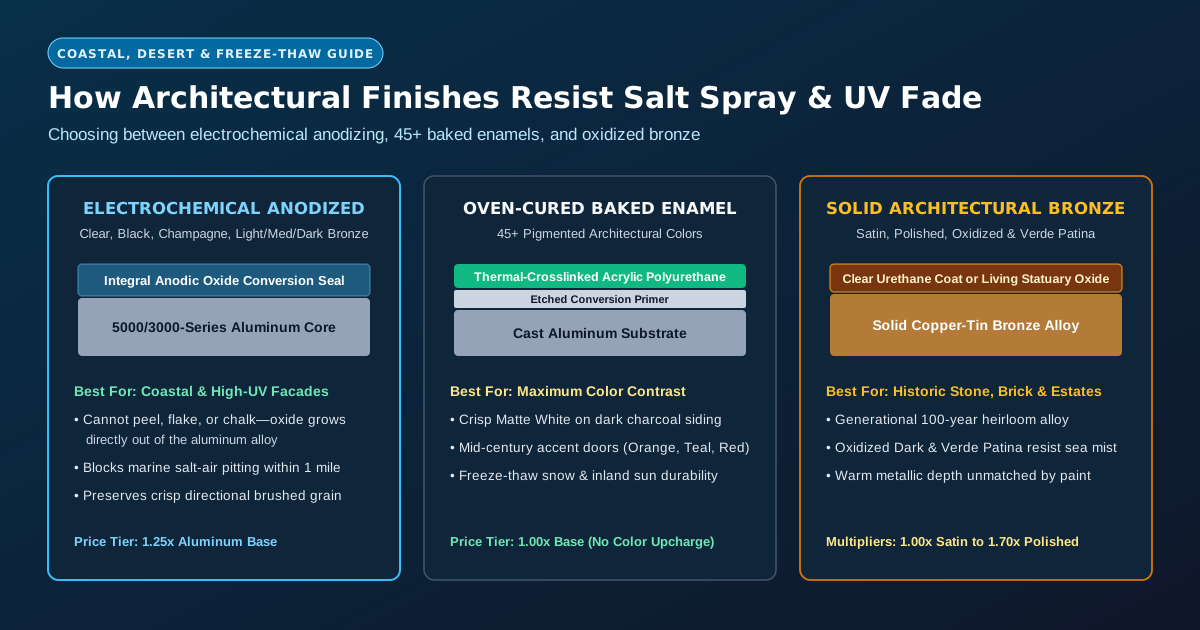
Foundry-cast architectural numbers are poured from corrosion-resistant non-ferrous alloys and finished by hand with directional satin belt-grinding, bead-blasting, electrochemical anodizing, or statuary bronze oxidation. Neither aluminum nor bronze contains iron, meaning neither metal can ever rust or stain light masonry with orange iron oxide. Better still, dimensional casting allows thick side returns—ranging from 0.50" on 4-inch slab serifs all the way to 1.50" on 6-inch Ribbon Deep and 3.00" on 24-inch monumental numerals—giving every character unmistakable three-dimensional sculpture even when mounted flush against the wall.
Three Distinct Profile Geometries: Flat-Face Cast, Prismatic V-Face & Cut Plate
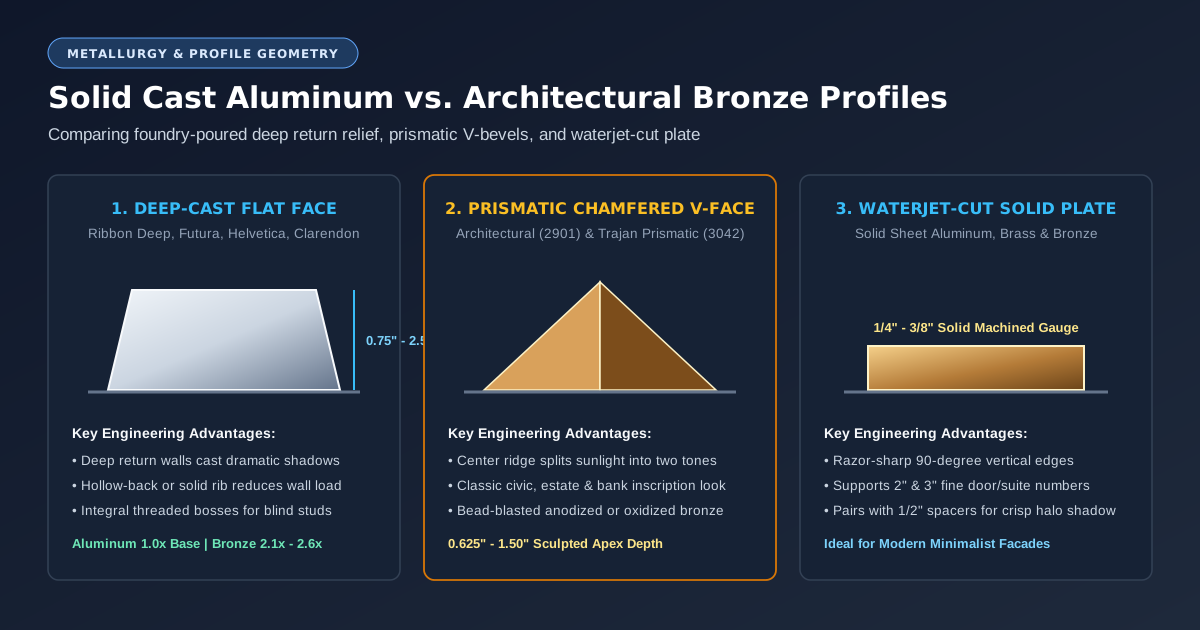
Before comparing aluminum against bronze, look closely at the cross-sectional geometry of the style you prefer, because profile shape governs how sunlight interacts with the face of every numeral:
- Deep-Cast Flat Face with Tapered Draft Returns: Styles such as Futura (
1.00"depth at 6"), Helvetica (0.75"depth at 6"), and our deepest relief profile, Ribbon Deep (1.50"depth at 6"), pair a clean, brushed front plane with deep side return walls. As the sun tracks across the elevation, those deep return walls project bold architectural shadows without needing standoff spacers. - Sculpted Prismatic V-Face: Styles Architectural (
#2901) and Trajan Bold Prismatic (#3042) rise to a crisp central apex ridge like classical hand-chiseled stone inscriptions. Because the two angled facets face opposite directions, one side catches bright specular daylight while the opposing facet falls into rich shadow, creating constant two-tone dimensionality even under overcast skies. - Precision Cut Solid Plate: For 2-inch and 3-inch door/suite numbers, intricate custom letterforms, or crisp ultra-modern edges, numbers are precision-cut from solid flat-rolled aluminum, brass, or bronze plate (
1/4"to3/8"gauge) with dead-square 90-degree vertical edges and tapped blind mounting bosses on the reverse.

Head-to-Head Comparison: Cast Aluminum vs. Solid Architectural Bronze
Both alloys carry a lifetime structural warranty and mount identically using concealed threaded pins. Their differences come down to color temperature, density, finish chemistry, and raw ingot cost:
| Specification | Solid Cast Aluminum | Solid Architectural Bronze |
|---|---|---|
| Color & Aesthetic Palette | Cool silver satin, Clear/Champagne/Gold/Bronze/Black Anodized, plus 45+ Baked Enamel colors. | Warm golden-copper Natural Satin, Mirror Polished, Statuary Oxidized, Dark Oxidized, and Verde Patina. |
| Physical Weight & Density | Lightweight (~0.098 lb/in³)—easy one-person installation even at 12" to 24" parapet heights. | Approximately 3x heavier (~0.315 lb/in³)—substantial heirloom heft prized on entry columns and stone piers. |
| Corrosion & Weathering | Zero rust; specify Anodized finishes (1.25x) for beachfront salt spray or high-alkali fresh stucco. | Generational marine & historic longevity; oxidized and patina finishes weather gracefully over decades. |
| 6-Inch Reference Pricing | $54 (Value tier, e.g. Helvetica) • $64 (Standard tier, e.g. Futura) • $83 (Prismatic). | $113 (Value tier) • $133 (Standard tier) • $159 (Prismatic) at 1.00x Satin Bronze base. |
| Finish Tier Multipliers | 1.00x Natural Satin & Baked Enamel • 1.25x all Anodized finishes. |
1.00x Natural Satin • 1.15x Oxidized • 1.30x Verde Patina • 1.70x Hand-Polished. |
When Aluminum Is the Smarter Specification
Solid cast aluminum is the workhorse of contemporary residential and commercial signage for good reason. If your exterior palette features brushed nickel hardware, stainless entry pulls, black steel casement windows, or anodized storefront mullions, aluminum finishes match that architectural metalwork seamlessly—and at less than half the raw material cost of copper-tin bronze.
Even when a project calls for a rich espresso or oil-rubbed bronze look on a budget, Medium Bronze Anodized and Dark Bronze Anodized aluminum deliver exceptional warm-bronze depth with electrochemical UV stability at only a 1.25x multiplier over base aluminum (for example, $80 per 6-inch Standard numeral versus $153 in Solid Oxidized Bronze). Likewise, if you are mounting 15-inch or 24-inch characters high on an EIFS commercial fascia or lightweight wood frieze, aluminum reduces dead-load weight on each stud anchor dramatically.
When Nothing Replaces Authentic Architectural Bronze
On red-brick Georgian colonials, Santa Barbara limestone estates, Craftsman river-rock piers, and historic preservation landmarks, genuine cast bronze brings an unmistakable organic warmth that aluminum cannot imitate. Natural Satin Bronze showcases fine horizontal grain lines glowing with warm champagne-gold undertones beneath a protective clear architectural urethane bake.
If your home features solid brass Baldwin or Rocky Mountain entry hardware, copper gutters, or warm travertine stonework, stepping up to Bronze Oxidized, Oxidized Dark, or hand-buffed Polished Bronze creates a cohesive front-entry material story that appreciates in character year after year.
Galvanic Compatibility: Matching Pin Hardware & Exterior Metals
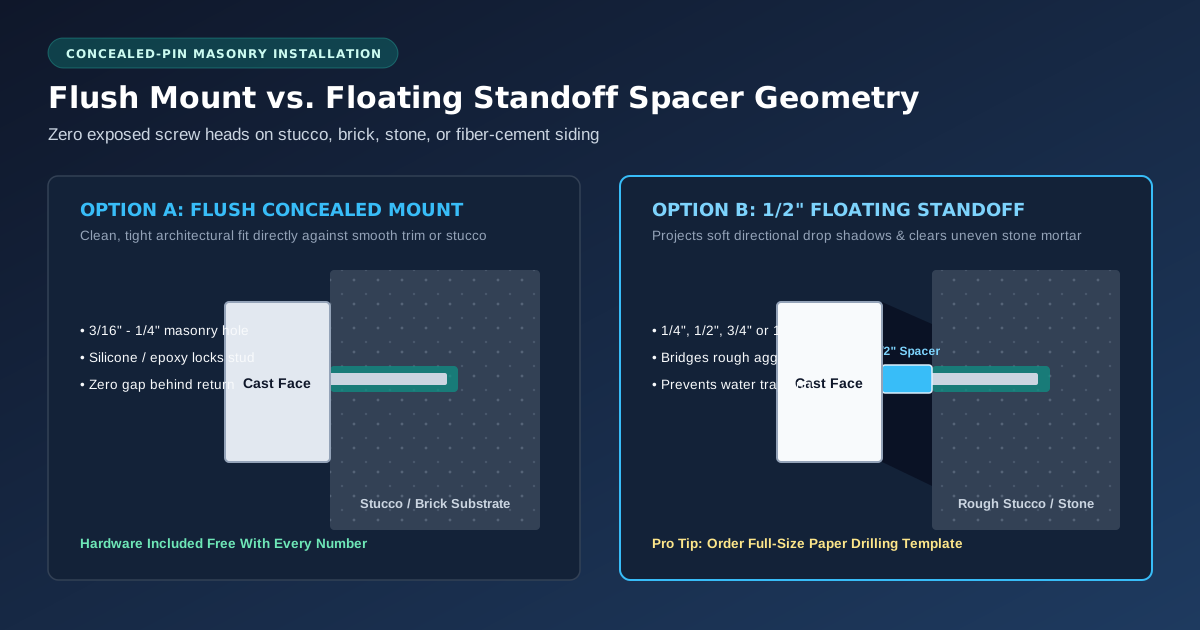
Architects specifying exterior signage onto metal rainscreen panels, copper flashing, or weathered Corten steel planters also need to account for galvanic compatibility between dissimilar metals. When rainwater containing dissolved electrolytes bridges copper-bearing bronze and bare aluminum directly, galvanic current can accelerate localized oxidation on the more anodic metal. Our shop threads corrosion-matched mounting studs into the rear bosses of each alloy and offers nylon or anodized standoff sleeves (1/4" to 1") that isolate the back of the character cleanly from conductive metal cladding while allowing air to circulate freely after rainstorms.
Ready to Price & Customize Your Own Set?
Select from 38 architectural fonts, heights from 2" to 24", 12 anodized & bronze finishes, or 45+ baked enamel colors—with full-size paper drilling templates available.