House Number Size Guide: Street Setback Math & Fire Code Visibility Rules
Choosing the height of exterior address numbers is one of the few architectural decisions where curb appeal and life-safety regulations intersect directly. Numbers that look substantial when held in your hand at a kitchen island often shrink to an unreadable sliver once mounted sixty feet back from the curb above a garage lintel.
Across residential remodels, custom home final inspections, and commercial certificate-of-occupancy walk-throughs, undersized or low-contrast address numbers remain one of the most common correction notices issued by local building and fire marshals. Fortunately, sizing architectural numbers accurately does not require guesswork. By combining the baseline requirements of the International Fire Code with optical sightline ratios and real foundry stroke-width measurements, you can select a character height that satisfies municipal inspectors while giving your facade balanced architectural presence.
What International Fire Code Section 505.1 Actually Requires
Most U.S. municipalities adopt Section 505.1 of the International Fire Code (IFC) and Section R319.1 of the International Residential Code (IRC) as their baseline standard for premise identification. While local jurisdictions in California, Florida, Texas, and wildfire-urban interface zones frequently amend the minimum height upward, the national model code establishes four non-negotiable criteria:
- Plain, Arabic Numerals: Addresses must be displayed in standard numerals (
0–9) rather than spelled-out script words (“Fourteen Twenty-Eight”), which slow down emergency recognition under stress or headlights. - Minimum 4-Inch Vertical Height: Characters must measure at least 4 inches (102 mm) from baseline to cap height for standard street-fronting dwellings.
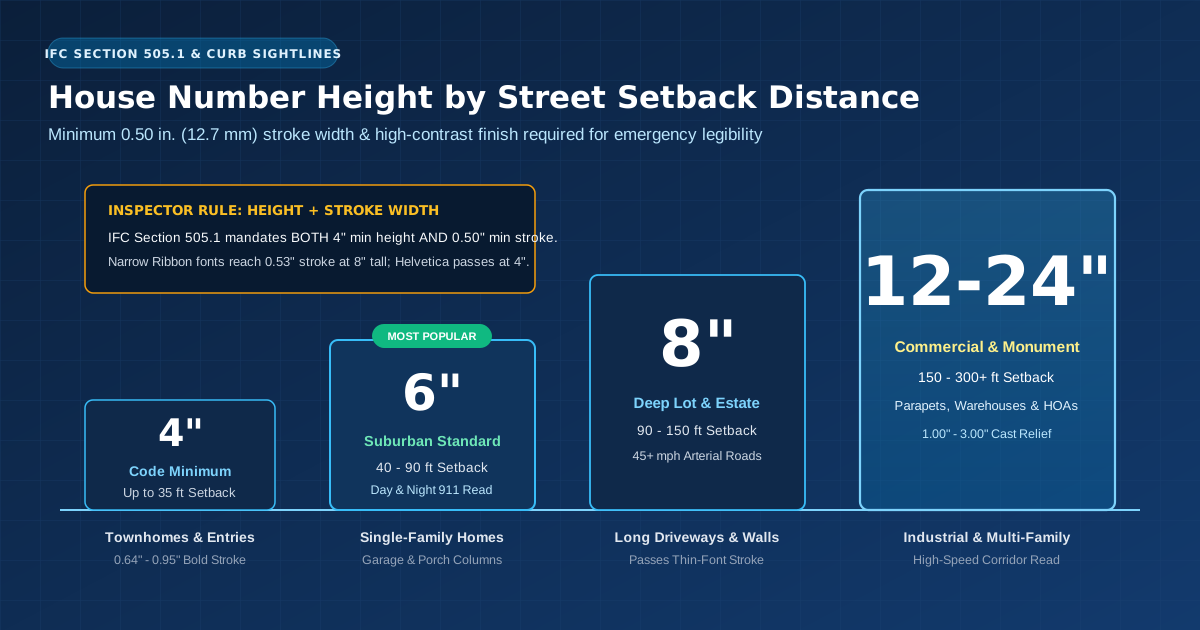
- Minimum 0.5-Inch Stroke Width: Every primary vertical stem of the numeral must measure at least 1/2 inch (12.7 mm) wide. Inspectors carry pocket rulers specifically to verify stroke width—not just overall height.
- High Contrast & Street Visibility: Numbers must contrast sharply with their mounting background and remain unobstructed from the street or road fronting the property in both daylight and nighttime emergency lighting.
0.26" face stroke—meaning you must step up to 8-inch Ribbon (0.53" stroke) to clear the 0.50-inch IFC stroke minimum. By contrast, bold styles like 4-inch Helvetica (0.95" stroke), 4-inch Futura (0.87" stroke), 4-inch Clarendon Medium (0.79" stroke), and 4-inch Architectural Prismatic (0.67" stroke) pass both height and stroke requirements right at 4 inches.
Sightline Geometry: Matching Character Height to Street Setback
Remember that 4 inches is a legal floor designed for urban rowhouses and zero-lot-line cottages sitting 15 to 30 feet from the curb. Human visual acuity for moving drivers—especially paramedics, fire apparatus operators, and evening delivery drivers scanning addresses at 25 to 45 mph—requires roughly 1 inch of numeral height for every 10 to 12 feet of viewing distance when paired with strong tonal contrast.
Before ordering, measure from the center of the street (not the front property sidewalk) to the exact wall plane, porch column, or masonry pier where the numbers will be mounted. Remember to factor in posted road speed: a home on a 45 mph suburban collector road needs larger characters than a home at the end of a 15 mph cul-de-sac, because drivers begin reading the facade much farther upstream.
| Center-of-Street Distance | Recommended Height | Typical Property & Mounting Zone | Foundry Stroke Width (Helvetica / Futura) |
|---|---|---|---|
| Under 30 ft | 3" – 4" | Interior apartment corridors, mailbox posts, urban townhome entry trim (verify 4" exterior code). | 0.71" – 0.95" (4" passes IFC stroke) |
| 35 – 75 ft | 6" | Standard suburban single-family porch columns, entry sidelights, and garage pilasters. | 1.31" – 1.42" |
| 75 – 130 ft | 8" – 10" | Deep front lawns, circular driveways, two-story gables, and 40+ mph arterial streets. | 1.74" – 1.89" (at 8") |
| 130 – 200 ft | 12" – 15" | Estate gate piers, commercial retail fascias, medical plazas, and multi-family buildings. | 2.62" – 3.55" |
| 200 – 350+ ft | 18" – 24" | Industrial tilt-up warehouses, highway-fronting campuses, and high parapet walls. | 4.04" – 5.68" (at 24") |
Why 6-Inch and 8-Inch Cast Numbers Dominate Custom Residential Projects
When reviewing thousands of homeowner and architect orders across the United States, 6-inch and 8-inch cast numbers account for the overwhelming majority of primary exterior installations. At 6 inches tall, a four-digit address such as 1428 spans roughly 18 to 22 inches horizontally depending on kerning and font width—wide enough to anchor a 10-inch cedar post vertically or sit centered above a coach lantern without crowding adjacent trim boards.

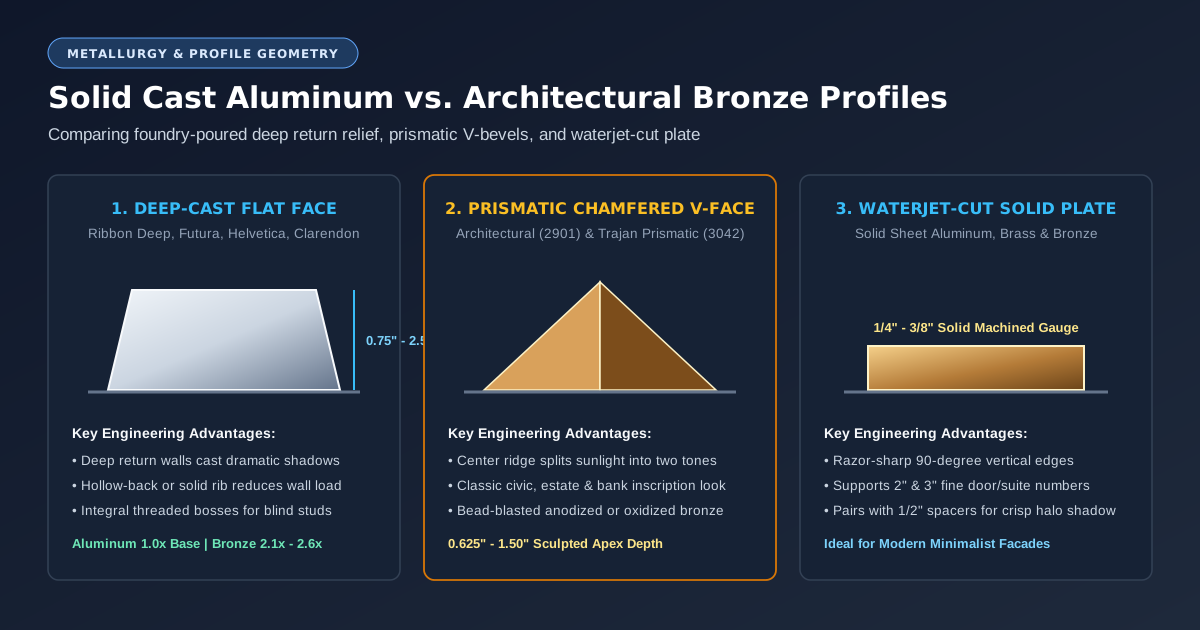
Stepping up to 8-inch or 12-inch numbers transforms the address from a utilitarian label into a deliberate architectural focal point. On wide horizontal garage headers, board-and-batten gables, or split-face CMU site walls, 4-inch numbers look visually timid, whereas 8-inch cast aluminum numbers with a 0.75" to 1.75" cast return depth hold their own against oversized modern pivot doors and architectural sconce lighting.
Calculating Horizontal & Vertical Wall Clearance Before You Order
Before finalizing your height in the online price configurator, take two quick tape-measure checks on your mounting surface so your paper drilling template fits with breathing room:
- Horizontal Layout Width: Standard architectural fonts average a character width of
65%to75%of their height, plus20%to30%inter-character spacing. Multiply your chosen height by0.95per digit as a safe rule of thumb. For example, four 6-inch numerals need roughly22 to 24 inchesof clear horizontal width, plus at least 2 inches of margin on both ends. Condensed typefaces such as Ribbon Condensed or Helvetica Medium Condensed trim horizontal width by roughly 20% for narrow door casings. - Vertical Stack Height: Mounting numerals vertically on a narrow 6-inch porch column is a classic solution when horizontal frieze space is tight. Allow
1.20xthe character height per digit from top of first numeral to bottom of last—meaning four 5-inch numerals stacked vertically require roughly 23 to 24 inches of vertical post height.
Luminance Contrast & Nighttime Headlight Legibility
Even a 10-inch number becomes invisible at dusk if you mount Dark Bronze Anodized metal onto dark espresso wood siding or charcoal brick. Fire marshals evaluate tonal value contrast—light metal against dark masonry, or dark metal against light stucco—rather than hue alone:
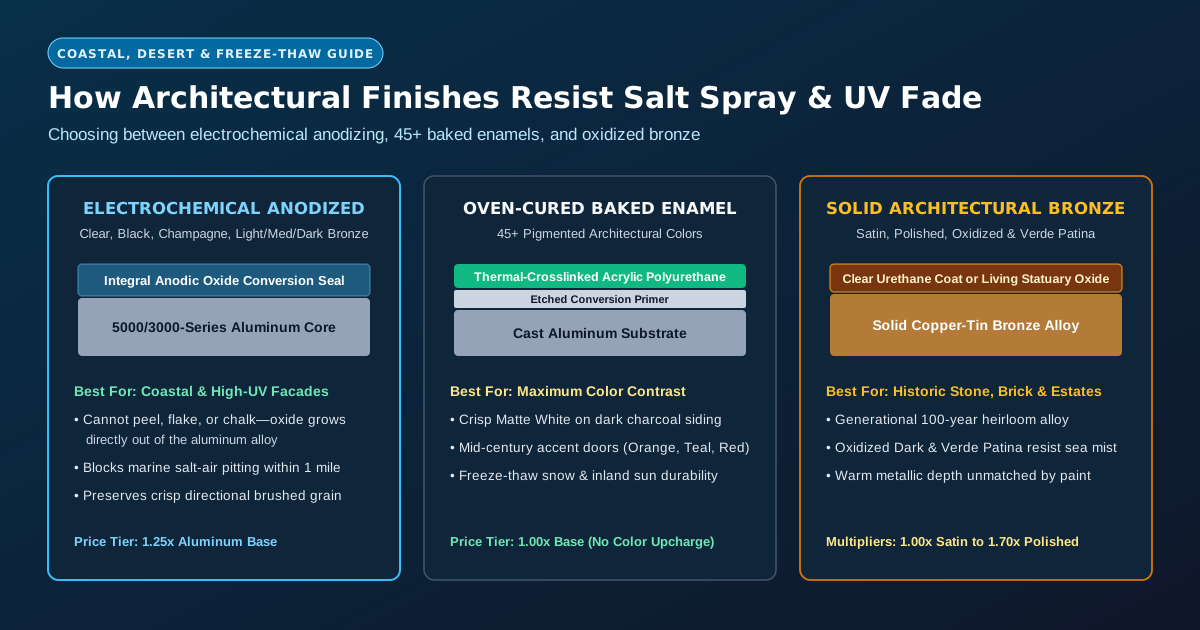
- Light Stucco, White Board-and-Batten, Cream Limestone & Pale Brick: Specify Black Anodized, Dark Bronze Anodized, Bronze Oxidized Dark, or Matte Black Baked Enamel.
- Charcoal Siding, Dark Walnut Cedar, Red-Brown Brick & Slate Stone: Specify Natural Satin Aluminum, Clear Anodized, Champagne Anodized, Satin or Polished Bronze, or Crisp White Baked Enamel.
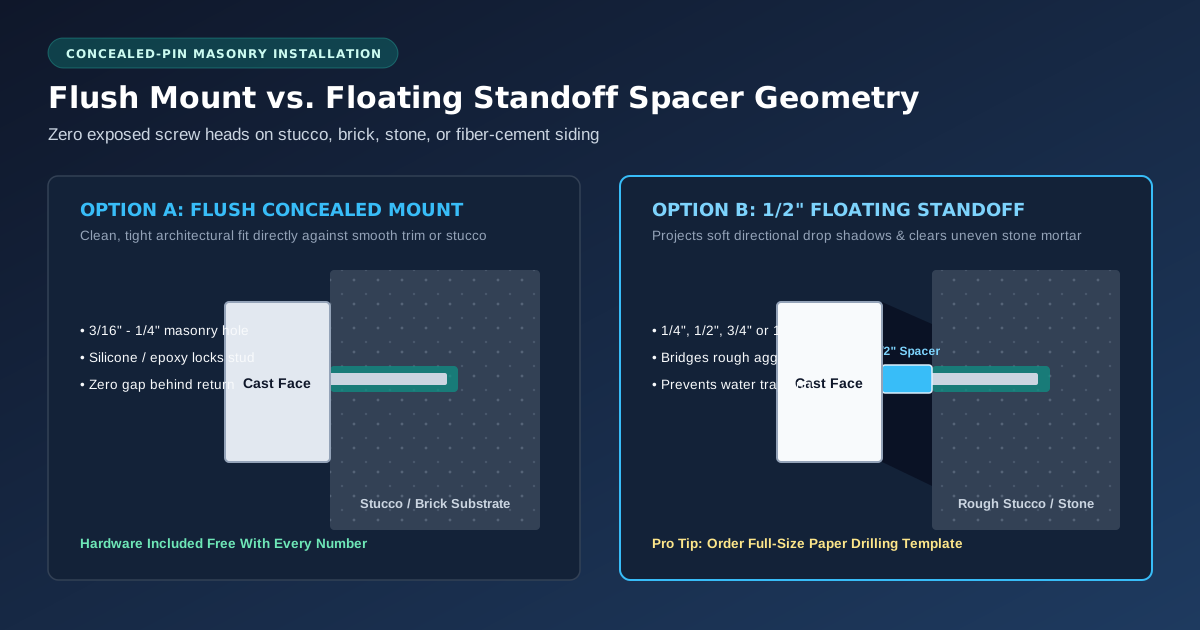
- Raking Sconce Lighting & Floating Spacers: Mounting numbers under an exterior downlight with
1/2"floating standoff sleeves casts a crisp shadow halo onto textured stucco during the day and under porch lighting at night—Note, however, that fire inspectors require contrast between the numeral face itself and the wall, not shadow contrast alone.
Ready to Price & Customize Your Own Set?
Select from 38 architectural fonts, heights from 2" to 24", 12 anodized & bronze finishes, or 45+ baked enamel colors—with full-size paper drilling templates available.